
The Six Fundamentals Of Health
Following my previous article, “First things first” (if you haven't, please give that a read before this), I emphasized on mastering our fundamentals before we proceed on to technicalities—here in the context of health, but also in any other field. Since many informative sources are available for each of these fundamentals, likely hundreds of books within these six topics, I have attempted to distill the essentials from these topics into what I would like to present to my clients during my sessions.
Here’s a quick summary of the article.
The SIX Fundamentals are:
Whole Foods Diet:
Have your diet consist of a wide variety of whole foods, follow your body’s instinctual cravings, and you will cover most of your nutritional needs.
Regular Movement, Fun Exercise
Seek out movement as much as you can throughout the day. Find an “exercise” that turns you on and feels like play rather than a chore.
Proper Sleep Hygiene
Allow your body to sleep 7-9h every night. Essential for every other function of the body to operate optimally.
Low Stress Rhythms
Prioritize peace. Exist with low-stress. Long-term stress destroys health.
Proper Breathing
Breathe with your nose only, and utilize your diaphragm to access your full lung volume. Breathing shapes your facial structures and if improperly done, can set you up for diseases later on.
Clean Environment with Nature
Connect to the earth and nature as much as you can, minimise external pollution as much as you can, and prioritize peace within to maintain it with-out.
Let's begin with a visual analogy from construction. Imagine if we try to build a house without its foundation‒installing the walls, roof, windows, piping, etcetera. The moment a storm comes, the whole structure is bound to collapse.
The following fundamentals outlined all work together and support each other to build our foundation of health. If any one of these are lacking, the foundation becomes compromised over time.
So let's see how we can build a damned solid foundation.
Fundamental #1: Whole foods Diet
This follows my “The ONE Thing” article. It’s a five-minute read to clearly understand this fundamental.
Having your diet consist of whole foods as a wide variety of:
fruits
vegetables
nuts and seeds
meat, organs, & animal products (dairy, honey, etc.)
seafood
wholegrains
various fermented products (yogurt, kefir, kombucha, etc.)
It bears repeating here: You are made of what you eat.
You can look up countless anecdotes of people recovering from their chronic ailments or making huge gains in weight loss once they made the shift to whole foods.
If you can nail this down as your modus operandi, everything else follows and gets exponentially easier. This is your 80/20 to strive for.
Here's the common sense: when we provide the proper building materials for repairing and building the body, all metabolic processes operate optimally, allowing for better sleep, better immunity, better hormonal regulation, and better neural integration and recovery from the previous day.
Fundamental #2: Regular Movement, Fun Exercise
I like thinking about our primal ancestors and their lifestyles. They never sat down hunched over staring at blue screens for eight hours everyday. They weren't able to doomscroll at the slightest moment of boredom. They rose with the sun, walked for many miles everyday, focusing on foraging and hunting for their fare. I encourage you to emulate that frequency of movement and activity as much as your lifestyle can allow‒design your lifestyle around it so that you look forward to it everyday. I walk my clients through this during our consultations.
I personally don't like thinking of exercise as exercise. Let me explain.
In our modern civilized societies, we have lost the daily motions and activities that gave our ancestors their fitness and resilience. They weren't being active and physical because they wanted to “exercise” for their health. They weren't thinking, "I should do these because it's going to make me X% less prone to heart disease." They were doing it because it was their way of life. The hunter-gatherer rose with the sun to forage or hunt for food. Likewise, the farmer would tend to their crops and animals. Otherwise, neglecting these tasks meant starvation down the line.
The physical nature and intensity of these tasks kept them fit and robust, often till old age. Many centenarians of blue zones around the world routinely get outside to work with their hands until the day they die. In Sardinia, many older men historically walked steep mountain terrain daily while shepherding. In Okinawa, older adults commonly garden and sit on the floor, requiring frequent standing and squatting. In Ikaria, hilly terrain naturally promotes walking into old age. They don't retire from manual labour at 65. It is their way of life.
That being said, most of us aren't born into countryside where we get to partake in manual work everyday. If you're reading this, it's likely you're like me, born into a city where everything's been done for us, and all we have to do is head to our nearest grocery store to pick the prettiest produce without blemishes. It is not a coincidence that the slower paced Mediterranean lifestyle accustomed to walking more in the day-to-day, correlates to longer lifespans and better health outcomes (1).
Again personally, thinking of exercise as exercise kills the fun in it for me. I do an exercise only because I enjoy the challenge and experience of it. And my body tells me exactly what kind of activity I feel like doing. In the mornings when my body is still sluggish and cold, especially in cold climates, I often enjoy doing a bunch of push-ups and pull-ups to get my body warm. Sometimes I like the skipping rope to get my heartrate up, but other times I prefer a relaxed jog or long hike. I've observed some people lashing a mental whipping on themselves for "discipline" to consistently exercise. Unsurprisingly, procrastination and inconsistency usually follow, ergo, ineffective in the long-term‒a common result of most popular prescriptions.
People that see extra layers to the exercise‒whether it be for quietening the mind, relaxation, fun, experience, challenge, mastery, or all of the above‒instead of thinking about weight loss or health benefits, have a much easier time staying consistent. We've all forced ourselves on the treadmill before. How's that turned out?
An easier and more effective approach is to incorporate more movement everyday than to block out dedicated time to “exercise”. Suggestions: do something in the morning to loosen and warm up, qigong, tai chi, many forms of yoga; get up every 30 minutes to one hour to stretch; do some push-ups or squats; or go for a quick sprint outside the block; always opt for stairs instead of elevators; park at the furthest end of the carpark; walk 20 minutes to the store instead of taking the bus. You choose your movement.
With that being said, let's look at the rational scientific consensus on this.
Exercise has consistently been shown to improve multiple aspects of health and metabolism, including cardiovascular function, insulin sensitivity, body composition, mental health, and overall mortality risk (2). Benefits to our systems include: our mental health, cardiovascular health, bone health, hormonal balance, digestive function, sleep quality, circadian rhythm regulation. Find me another therapy that can top that.
If you don't know where to start, pick just ONE thing that is the least time and effort for you to commit to. Skipping rope, rebounding (bouncing on trampoline), brisk walking around the park or neighbourhood, high intensity interval training, yoga, tai chi etc. Or recall what you really enjoyed playing in your adolescent years and find a local group to join. Following my aforementioned approach, the goal is to take small steps that are FUN, turn you on, and make you feel GOOD. Build momentum with small steps towards higher commitment activities like sports or hiking.
The top performers of their respective fields, like CEOs, investors, and doctors, excluding professional athletes obviously, all understand that health is imperative to their elite performance. They usually have an enjoyable activity that is playtime to them, or they seek out challenges that become a pursuit of mastery in mental and physical training. Look up Ironman Triathletes' stories and you'll be thoroughly impressed to see how many of them are regular full-time performers in their own professional fields. A cool example recently is Gordan Ramsay, at 58, finishing the Ironman 70.3 in under 7 hours.
There is no holy grail for the best exercise for health, your holy grail is the one that gets you moving and playing. My holy grail is rock climbing. I personally go climbing about 4-5 times a week but I don't see any of that time as exercise. Why? Because I see it as a pursuit of mastery, and also because it's so multifaceted and ridiculously fun. That's why.
The takeaway: Move more throughout the day. Find your form of exercise that feels more like fun and playtime, with many layers to learn, so you can easily stay consistent and motivated.
Fundamental #3: Proper Sleep Hygiene
Here are the key points from the fantastic book, "Why We Sleep" by sleep researcher Matthew Walker.
Adults need 7-9 hours of sleep. "I only need 6 hours" is self-deception. They've simply forgotten what fully rested feels like.
Sleep deprivation is cumulative. You cannot "catch up on sleep" during the weekends; the damage compounds.
Sleep before learning prepares your brain to absorb information; sleep after learning consolidates it‒ergo, it is essential for integrating and improving at anything you're learning.
Even moderate sleep loss impairs cognitive function as much as alcohol intoxication.
Chronic sleep deprivation increases risk of cancer, heart disease, diabetes, Alzheimer's, and mental health disorders.
Caffeine, alcohol, and screens are the three biggest sleep disruptors in modern life.
Your circadian rhythm is built into your DNA. Fighting it has consequences.
My favourite quotes from the book:
"The shorter your sleep, the shorter your life span."
"Sleep is the single most effective thing we can do to reset our brain and body health each day."
"There is no major organ or process in the brain that is not optimally enhanced by sleep."
"Routinely sleeping less than six or seven hours a night demolishes your immune system."
Matthew's tips for sleeping
Keep a consistent sleep schedule (even on weekends)
Avoid caffeine after noon
Avoid alcohol near bedtime (it fragments sleep)
Keep your bedroom cool (65°F/18°C is optimal)
Minimize blue light exposure in the evening
Avoid screens 1-2 hours before bed
Get natural light exposure during the day
Don't lie in bed awake‒if you can't sleep, get up and do something relaxing.
Fundamental #4: Low Stress Rhythm
We were not made to withstand chronic stress.
Long-term chronic stress promotes chronic inflammation in the body, and chronic inflammation is associated with all our modern chronic diseases like cancer, diabetes, heart disease, and auto-immune diseases like rheumatoid arthritis (3,4).
Here's a quick lesson on our two antagonistic neural systems:
Your Sympathetic Neural System (SNS) known as the classic fight or flight mode, kicks into action during emergencies (or perceived emergencies). This is what makes you go double-quick-time! if a lion starts chasing your ass down.
Your Parasympathetic Neural System (PNS) plays a completely opposite role. Lesser known as the “rest and digest” mode, it acts as the body's braking system to conserve energy and promote calmness. It slows the heart rate, stimulates digestion, activates waste elimination, and lowers stress.
Ways to stimulate the PNS, the “rest and digest” mode:
Breathwork
Deep, relaxed diaphragmatic breathing. Everyone should know this as their default breathing pattern. Breathe deeply into your belly, not your chest, to activate the diaphragm, which stimulates the vagus nerve. (More on this below)
Exhalation twice as long as inhalation. Intentional stimulation of the vagus nerve, which is what governs the PNS. Breathe in with your nose for 4s, breathe out with your mouth (pursed lips with small opening) for 8s
Humming, singing, chanting
low-pitched vibration in the vocal cords stimulates the vagus nerve
Cold exposure
Ice baths, ending on cold showers for 30s
Ear massage
inner ear area is rich in vagus nerve fibers
Physical activities
Gentle Yoga
Tai Chi & Qi Gong
Massage therapies
Walks in nature
Interesting note, about 75% of cases of insomnia are triggered by some major stressor. Stress not only disrupts the the total amount of sleep but can decrease the quality of sleep. It disproportionally reduces your deep sleep (slow wave sleep), which is what you need for energy restoration.
We’re talking about mental stress here, not the physical stress of someone putting a gun to your head trying to rob you. There are too many ways to “manage, reduce, or cope,” with stress, and I will not attempt to list them here. With a rational biological perspective, maintaining the PNS, “rest and digest” mode as our status quo should be the default setting for any creature. Humans are the only creatures in the animal kingdom capable of inventing stress and deplete their quality of life and health over it. Excluding a physical traumatic life-or-death event, my personal take on stress—that has worked for me—is that it is far more effective to truly understand the causes of stress such that it no longer bothers you. It is about the awareness of your perspective you have taken on the matter, perhaps ignorantly, that makes your stress a reality. The fact that adolescents of society are committing suicide—many due to specific pressures like educational success—are testament to how warped our minds can become about what is truly required for living a good life.
The bottom line is, either you remove your sources of stress in life, or you investigate the causes of your stressors and alter your perspective such that they no longer bother you. Easier said than done—but “easier said than done” applies to anything in life that actually matters to us. Right?
Here's a beautiful uplifting quote by Robert Sapolsky in his seminal book on stress, Why Zebras Don't Get Ulcers:
“God grant me the serenity to accept the things I cannot change, courage to change the things I can, and wisdom to know the difference—have the wisdom to pick your battles. And once you have, the flexibility and resiliency of strategies to use in those battles are summarized in something I once heard: in the face of strong winds, let me be a blade of grass; in the face of strong walls, let me be a gale of wind.
In our privileged lives, we are uniquely smart enough to have invented stressors and uniquely foolish enough to have let them, too often, dominate our lives. Surely we have the potential to be uniquely wise enough to banish their stressful hold”
Fundamental #5: Proper Breathing
Breathing Law #1: Inhale only with your nose. Period. Your nose is built as the organ to inhale air for the body, not your mouth.
Why is that? It contains nose hair that acts as the first line of defense to trap large particles in the air. Your mouth doesn't. Thank god. Imagine hair growing in our mouths. In our sinuses, lie the turbinates (conchae). These are three pairs of scroll-like, bony structures that protrude into the nasal cavity. They create turbulence in the air, forcing it to spiral so it makes maximum contact with the warm mucous membrane. This contact heats up the air to our body temperature, and raises its humidity to 100%‒all this within milliseconds‒to then enter our lungs. That's why we can breathe the air even when it's -30℃ outside. When we breathe with our mouths, we bypass our wonderful natural air filter, warmer, and humidifier for the air going into our lungs, and consequently end up with dry mouths, sore throats, tonsilitis, and sinusitis. Mouth-breathing is also causes fatigue, brain fog, and waking up feeling unrefreshed (5).
Chronic mouth breathing can also cause long-term facial changes, such as a narrow face or a receding jaw is associated with our modern dental problems. How? When breathing through the mouth, the tongue rests on the floor of the mouth instead of against the palate (roof). This removes the natural structural support needed for proper upper jaw expansion. This is most prominent in children and pre-adolescents whose bones are still developing. Recent research is starting to show that people who mainly breathe through their mouths often develop a characteristic "long face syndrome." Aside from being a cosmetic issue, it can also cause functional problems such as sleep apnea and jaw disorders (6).
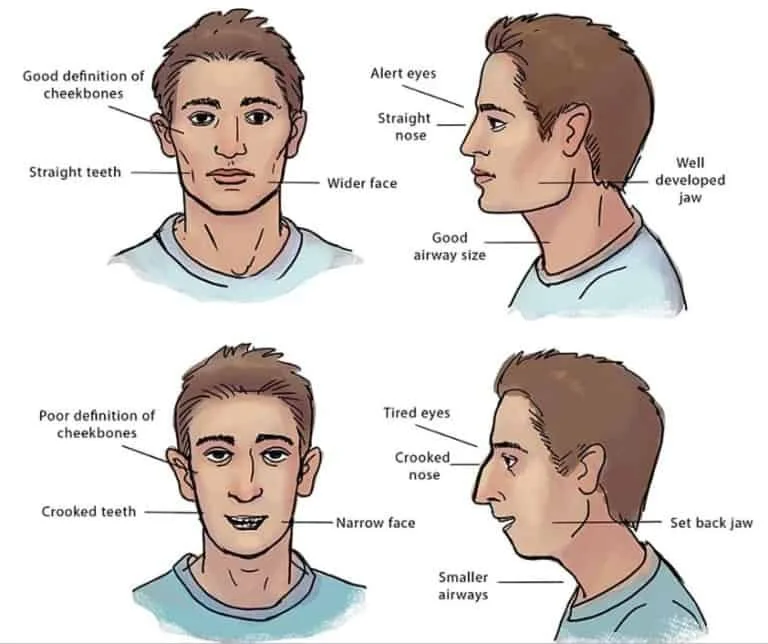
People who mouth breath have poor facial profile, small lower jaws and dwarfed looking mouths and droopy lips. Nasal breathing promotes healthy growth and development starting at a very young age (7).
List of dental problems from chronic mouth breathers:
Narrowing of the dental arches
Crowding of teeth
Increased risk of cavities due to dry mouth
Changes in the bite
Development of an open bite
Problems with jaw joint function
Dentists and orthodontists are noticing these patterns more frequently and clearly. They see that patients who primarily breathe through the mouth often require significantly more complex orthodontic treatments than others. Even if you use your nose to breathe most of the time while awake, you might unconsciously be mouth breathing while asleep—this was me. Throughout my childhood and adolescent years, I would often wake up with chronic sinusitis lasting for a few days. The sinusitis often times turned into colds, sore throats, and chesty coughs, until I learnt to tape my mouth to train my nose breathing while asleep. In 2022, while serving the army in my national service, despite my absurdly dusty army bunk at the time, after trying mouth-taping for one week, I adapted to consistently nose breathing while asleep. Ever since then, sinusitis has rarely made an appearance in my life again.
Key Indicators of Night-time Mouth Breathing
Morning Oral Health Issues: Waking up with a very dry mouth, sore throat, hoarseness, chapped lips, or bad breath (halitosis).
Sleep Symptoms: Loud snoring, waking up with a gasp, or waking up feeling unrefreshed and still tired.
Physical Evidence: Drooling on the pillow or finding the mouth open while resting.
Daytime Fatigue: Feeling tired, irritable, or having trouble concentrating during the day due to poor quality sleep.
How to tape your mouth
Don't worry you won't have to look like a kidnapped hostage at home. Just get any surgical tape (really cheap, no need to buy expensive branded mouth stickers) from the local pharmacy, tear off a piece measuring about 4cm x 2cm, and paste it in the middle of the lips, leaving gaps in the corners of your mouth to still breathe if necessary.
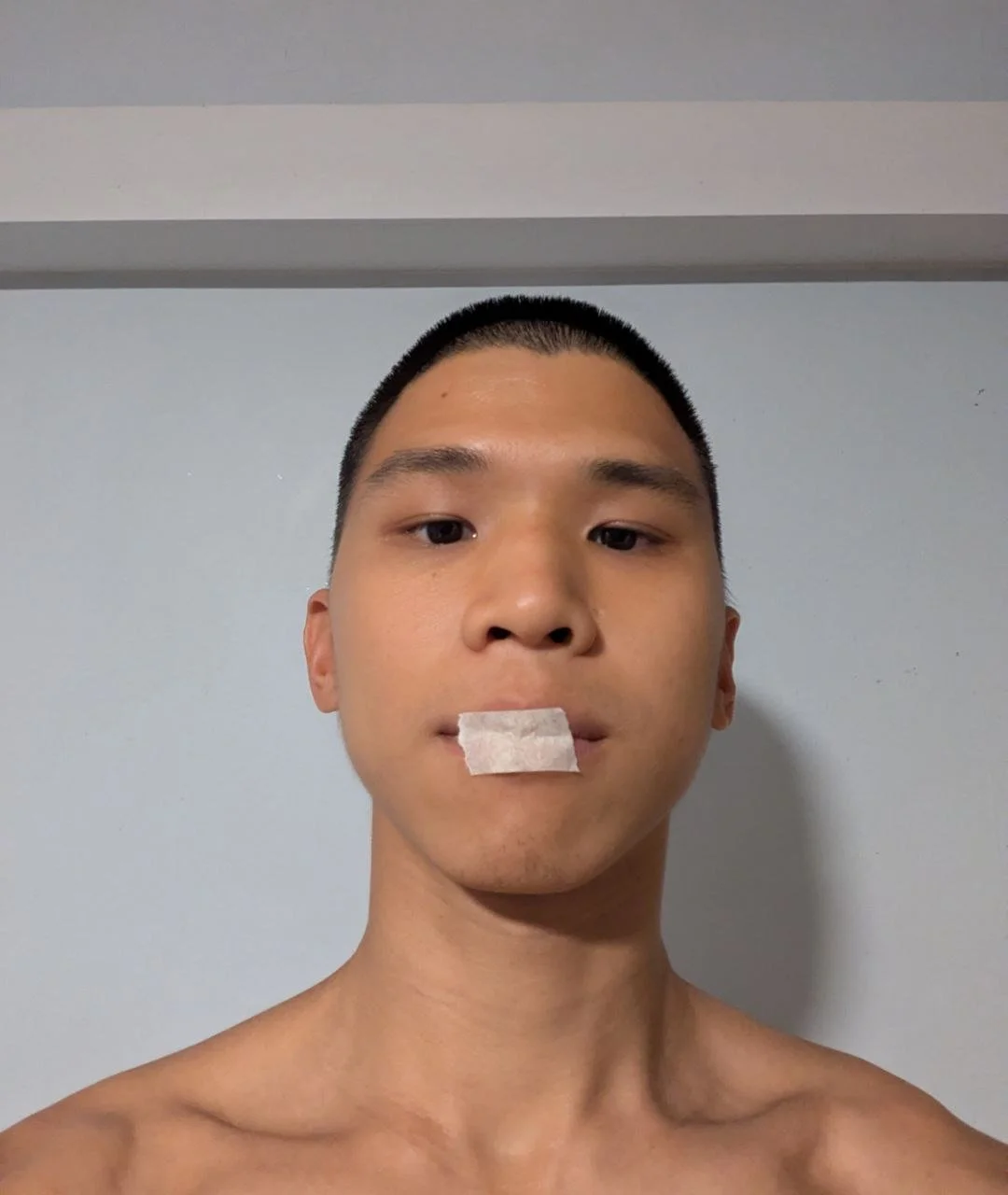
Example of yours truly, with a taped mouth.
I’m able to comfortably breathe with the corners of my mouth if I wish to. Feel free to make the “gap” bigger.
Breathing Law #2: Use your diaphragm to allow your belly to expand with every inhale. Period.
Your diaphragm is the body's dedicated respiratory muscle for breathing. It is supposed to be the primary muscle used for breathing. Upon inhalation, when the diaphragm contracts, it moves downward toward the abdominal cavity, creating negative pressure in the thoracic cavity, which allows the lungs to fill with air.
If you've ever observed dogs, cats, and babies while they sleep, you'll notice their bellies rising up and down along with every breath, through their nose.
Unfortunately, despite how it seems so instinctual and natural to animals to utilize their diaphragms, we have somehow lost this most fundamental knowledge of effectively using our diaphragms to bring our lung capacity to its full potential. Free-divers, swimmers, rowers, and singers understand this skill well. These endeavours require intense utilization of their diaphragmatic muscles on a regular consistent basis. As a result, these folks boast some of most impressive lung volumes and diaphragm control in the human population.
Using the diaphragm well ensures that every breath you inhale fully aspirates the lungs, both upper and lower lobes, and effectively provides more efficient oxygen exchange per breath than shallow chest breathing (8).
Most people are unaware that they shallow breathe, and consequently under utilize their lung capacities while letting their diaphragmatic muscles to atrophy. Adding biological insult to injury, shallow breathing (scaredy-cat upper chest breathing) inhibits the vagus nerve, which inhibits our PNS, the “rest and digest” mode, and easily puts us into the “fight or flight” mode, which in turn, increases the tendency for anxiety and triggers nervous system overstimulation (9, 10). This directly relates to promoting chronic stress as mentioned before, which can promote chronic inflammation.
It can be seen as a classic chicken and egg scenario, where shallow breathing begets stress and anxiety, and stress and anxiety begets more shallow breathing. One of the most therapeutic methods for calming down anxiety that psychotherapists prescribe is to take a few long and deep inhales followed even longer exhales. This is precisely because it stimulates the vagus nerve to calm the nervous system down.
Breathing practice can always be integrated into every moment of your life—since we're breathing every moment of our lives. Occasionally throughout the day, regardless of what you're doing, you can tune in to your breath and practice diaphragmatic breathing. Focus on slow, deep inhales, and feel your belly expanding far out, indicating you're reaching your maximal lung capacity. On the exhalation, gently exhale through the nose and try to push out the air in your lungs using your abdominal muscles until slightly straining. Aim for a full breath cycle of at 8-10 seconds. Repeat this day after day and overtime, you'll retrain your mind-body connection to breathing naturally and efficiently.
"Stop. please. It's not that you're not doing it right, it's that you don't know how to do it at all. Your body doesn't know how. I've been watching you. You yawn like it's illegal, you sneeze like a kitten, your voice is nasal and puny, you're never really relaxed. Learning to breathe is a big deal, it might take you a year to break bad habits and learn good ones. It's critical to everything, and it's not easy. You really have to put your attention on it: learn about it, develop the muscles, make it a habit. You have to retrain your mind and body. It's not a simple thing." "Oh my God," she says in exaggerated despair, "as if I don't have enough to worry about, now I don t know how to breathe!" "This comes before everything. If you don't breathe well, nothing else is going to work right: the mental, physical, and emotional stuff all relies on full, healthy breathing.
‒ Jed Mckenna speaking to Lisa, Spiritual Warfare
If you're interested in learning more about proper breathing, Breath by James Nestor is a must read.
Fundamental #6: Clean Environment With Nature
What does a clean environment entail?
One that allows our biology to be in harmony with the natural rhythms of the earth; one that does not chronically expose us to toxins and pollutants; one that promotes peace and tranquility as the default way of being.
Biology in harmony with Nature
The modern man is now chronically severed from the life-giving cradle of mother earth.
Many indigenous tribal societies around the world understood the value of staying connected to the soil through their bare feet, sleeping on the ground, and taking baths in rivers and oceans. They knew it was vital to their connection with the world around them, and by extension, Mother Nature. Likewise, the Tao says, "In dwelling, live close to the ground." What they didn't know was that this phenomenon which we now understand as grounding or earthing, is now finally being understood by science. And practically no one is aware of this: We have literally lost our roots.
What is Earthing?
It is the practice of making direct physical contact with the Earth's surface—such as walking barefoot on grass, soil, or sand—to absorb its natural negative electrical charge. The earth is essentially an infinite battery of free-floating negative electrons (six sextillion metric ton battery, that's six followed by twenty-one zeroes). When we connect ourselves to this battery, this transfer of electrons acts as a powerful antioxidant, helping to neutralize free radicals and restore bioelectrical balance in the body.
Clint Ober's seminal discovery written in the book, "Earthing, the most important health discovery ever" dispelled the “woo-woo” and placebo of the health benefits gained by connecting to our Mother Earth. Here's a list of benefits documented, with more being discovered and validated by scientific research (11):
Defuses the cause of inflammation, and improves or eliminates the symptoms of many inflammation-related disorders.
Reduces or eliminates chronic pain.
Improves sleep in most cases.
Increases energy.
Lowers stress and promotes calmness in the body by cooling down the nervous system and stress hormones.
Normalizes the body’s biological rhythms.
Thins blood and improves blood pressure and flow.
Relieves muscle tension and headaches.
Lessens hormonal and menstrual symptoms.
Dramatically speeds healing and helps prevent bedsores.
Reduces or eliminates jet lag.
Protects the body against potentially health-disturbing environmental electromagnetic fields (EMFs).
Accelerates recovery from intense athletic activity.
So get yourself an earthing mat to sleep on every night (I personally travel with one). Walk barefoot on the grass and dirt as much as you can. Dip and swim regularly in rivers and oceans.
Check out the book, or learn more at earthing.com.
Superior air quality in nature
In the days of yore, in ancient China, Taoist and Qi Gong masters esteemed the natural bounty that is abundant “Qi”, found in pristine natural environments like misty mountain ranges, raging majestic waterfalls, and lush old forests. They would practice tai chi and qi gong, a form of moving meditation grounded on breathwork, to build their reserves of Qi, the vital energy of life. They weren't just spouting metaphysical nonsense. We now understand this 'Qi' contained within lush environments as negative air ions (NAIs).
Negative air ions are electrically charged molecules that occur naturally in environments like forests, waterfalls, mountains, and oceans. They are generated through sunlight, moving water, plant activity, and atmospheric electricity. Forests tend to have especially high concentrations because vegetation and moisture help produce and sustain these ions. There is some scientific evidence suggesting that environments rich in negative air ions may contribute to feelings of calmness, improved mood, and perceived freshness of air (12). So get outside and afford yourself plenty of opportunity to savor this "stuff of life." Focus on reaaaaallyyyyyy slowing down to thoroughly experience the freshness of each breath. Find a nice spot to practice your preferred choice of moving meditation (tai chi, qi gong, various yoga), or simply have breathing meditations. Yet another reminder of how Mother Earth provides for her children.
Clean from chronic exposure to toxins and pollutants
Unfortunately, in our modern world, an environment clean from mankind's pollution has become impossible. From microplastics found in virtually all marine creatures and habitats—Antarctica to the Mariana Trench—to PFAS (forever chemicals generated from the production of waterproof, non-reactive coatings like teflon) floating down from the atmosphere, leeching into the global water cycle, detected even in the remotest parts of the Amazon rainforest and Arctic glaciers (in polar bears!), indeed, we are living in toxic times. Without going into environmentalism and bio-activism, the reality for most of us living in civilized society is that we are chronically exposed to toxins from all sides. It is deeply concerning that the warnings presented in Silent Spring by Rachel Carson in 1962 still resonate today: the book exposed the detrimental effects of indiscriminate pesticide use, particularly DDT, on the environment and human health. A disheartening account of environmental manipulation and the spread of disinformation by those wielding immense power remains strikingly relevant in our contemporary world.
“A Who's Who of pesticides is therefore of concern to us all. If we are going to live so intimately with these chemicals eating and drinking them, taking them into the very marrow of our bones - we had better know something about their nature and their power.”
“We are accustomed to look for the gross and immediate effects and to ignore all else. Unless this appears promptly and in such obvious form that it cannot be ignored, we deny the existence of hazard. Even research men suffer from the handicap of inadequate methods of detecting the beginnings of injury. The lack of sufficiently delicate methods to detect injury before symptoms appear is one of the great unsolved problems in medicine.”
‒ Rachel Carson, Silent Spring
In other words, we barely know anything about the substances we're putting in and around us at every level, starting from our households, to the greater city environments, and all the way out to the arctic poles. It is almost impossible for science to effectively measure the compounding effects of such exposures on our health‒not to mention the difficulty of the likely extravagant funding required for undertaking such research. We are quite literally, as Jules Winnfield of Pulp Fiction says in that infamous scene, "beset on all sides by the iniquities of the selfish and tyranny of evil men."
Top TEN pollutants in our modern environment
Air Pollution: Vehicle emissions, industrial activities, and household products can contain harmful chemicals and particulate matter that can contribute to respiratory problems, cardiovascular issues, and other health concerns.
Pesticides: Pesticides used in agriculture and pest control contain toxic chemicals that can be harmful to human health. These chemicals can be found on conventionally grown produce and in our water supply. Refer to the Clean Fifteen and Dirty Dozen for which produce is most pesticide-free or pesticide-laden. Buy organic as much as you can, especially for those on the dirty dozen.
Household Cleaners: Many household cleaners contain toxic chemicals such as phthalates, ammonia, and bleach that can be harmful when inhaled or absorbed through the skin. Opting for natural, non-toxic cleaning products can help reduce exposure.
Food Additives: Certain food additives like artificial colours, flavours, and preservatives can have negative effects on health, including allergies, hyperactivity, and digestive issues. Choosing organic and minimally processed foods can help reduce exposure to these additives.
Heavy Metals: Exposure to heavy metals like lead, mercury, and aluminium can occur through contaminated water, food, dental procedures, and consumer products. These metals can accumulate in the body over time and contribute to a staggering range of health issues.
Personal Care Products: Many personal care products, such as makeup, skincare, and hair care items, contain toxic ingredients like parabens, phthalates, and formaldehyde-releasing preservatives. Opt for natural and organic products.
Plastic Pollution: Plastic products can leach harmful chemicals like bisphenol A (BPA) and phthalates into food and beverages, especially when heated. Never reheat your consumables in plasticware. Use glass, ceramic, or steel.
EMF Radiation: Electromagnetic fields (EMFs) from electronic devices like cell phones, Wi-Fi routers, and microwaves have been linked to health concerns such as headaches, sleep disturbances, and possibly even cancer. Limiting exposure to EMFs and using protective devices (like earthing mats) can help mitigate these risks.
Indoor Mold: Mold growth in homes can produce allergens, irritants, and mycotoxins that can affect indoor air quality and lead to respiratory issues, allergies, and other health problems. Proper ventilation and moisture control can help prevent mold growth. Consider getting a specialist to conduct a check on the air quality and household exposure.
Volatile Organic Compounds (VOCs): VOCs are chemicals found in paints, furniture, carpets, and building materials, used as flame retardants, that can off-gas into the air and contribute to indoor dust and air pollution. Choosing low-VOC or VOC-free products can help improve indoor air quality.
On top of reducing exposure, ensuring a wholesome diet of whole foods, especially having a rainbow of fruits and veggies, ensures that our detoxification mechanisms and antioxidant capacities stay efficient and effective. Those living in more polluted cities with higher levels of exposure to toxins may wish to learn more about detox measures like fasting and juicing.
Peace and tranquillity as the status quo
This is strongly related to our earlier points on living with low stress and proper breathing.
Think of the words peace and tranquility, of the images that come to mind, what do they have in common? Perhaps it's silence; perhaps it's the sounds of nature: the river rushing, birds singing, waves crashing, wind blowing. The commonality we're thinking of is an environment that promotes calmness. There is nothing rushing, nothing blaring, nothing over-stimulating. Contrast that with the default setting of an urban bustling city where everything everywhere is happening all at once, and the mind is bombarded with stimuli non-stop. Everything in the urban world is out to grab your attention (my apartment block elevator has a newly installed screen for ads‒thanks gov!). We unwillingly (and ignorantly) become little sheep in a world of capitalist wolves‒are we in the Matrix? With the mind-boggling rate of technological advancements and artificial intelligence on our shores now, the true target that techno-capitalism‒now the biggest players of the global free market‒aims for is your attention, your desires, and consequently your personal data. Blatant ads, subtle ads, surveillance capitalism permeates everything we use to operate in society and online, constantly feeding us more personalized ads, in hyper-stimulating-dopamine-hacking-doom-scrolling-short-form content shortening our attention spans more than ever, keeping us wired to our screens, glassy-eyed, slacked-jawed, chronically tired, hunchbacked, always bored, craving for more stimulation, hungry for more fleeting pleasures. It's a pitiful sight.
The ones that see through this are the ones that manage to stay afloat, albeit with constant temptation to sink back down, like a fresh clean drug addict. What then?
“If you get the inside right, the outside will fall into place.”
‒ Eckhart Tolle
The inside that Eckhart is referring to is our internal state of affairs going on 24/7 in our monkey mind. Unfortunately for most of us, worry, anxiety, and stress, are dirty tenants living rent-free in our heads—or fortunately, as it is only a matter of ignorance. I won't delve into spiritual or philosophical ramblings about understanding the causes of our mental suffering, but I beseech you, my reader, to investigate your causes sincerely. Cultivate awareness over your life. Ask yourself: Am I aware of them? Why do they arise? How have I allowed them to arise? Have I conceded to simply managing them? What are the true consequences of the status quo? Be honest with thyself. This is a similar process one needs to go through to revive their lost vitality and embark on the journey of health. As Socrates said, "the unexamined life is not worth living." That’s some real shit right there.
We absolutely cannot ignore the external environmental factors that go into influencing our internal conditioning, i.e. our GPS and OS for navigating our lives. However, we do have a choice in the noise and interference coming in—that can and must be eliminated—if we are to strive for abiding internal peace. Awareness is requisite to inner tranquillity. Peace and tranquillity are entirely within your grasp.
Conclusion
Returning to the analogy mentioned earlier, the storm blowing down our house can represent any externality in the environment that can disrupt our health. This includes infectious pathogens like bacteria, fungi, and viruses, various food and chemical additives, environmental pollution and carcinogens. If we are able to stay grounded upon a solid foundation, the likelihood of structural failure and imminent collapse are drastically decreased. So have these six fundamentals be the centre of your personal wheel of life. You may then customize and embellish your spokes and the peripherals with your bio-individual requirements.
As the Chinese proverb goes: “The best time to plant a tree was 20 years ago. The second-best time is now.”
“Thousands of tired, nerve-shaken, over-civilized people are beginning to find out that going to the mountains is going home; that wildness is a necessity”
— John Muir, Our National Parks
“Every spirit builds itself a house; and beyond its house a world; and beyond its world, a heaven. Know then, that the world exists for you. For you is the phenomenon perfect. What we are, that only can we see. All that Adam had, all that Caesar could, you have and can do. Adam called his house, heaven and earth; Caesar called his house, Rome; you perhaps call yours, a cobbler's trade; a hundred acres of ploughed land; or a scholar's garret. Yet line for line and point for point, your dominion is as great as theirs, though without fine names. Build, therefore, your own world.”
— Ralph Waldo Emerson, Nature
References
Sidossis A, Tambalis KD, Itsiopoulos C, et al. Effects of traditional mediterranean physical activity on physical and mental health: a systematic review. Am J Lifestyle Med. April 2026:15598276261441548. doi:10.1177/15598276261441548
Thompson WR, Sallis R, Joy E, Jaworski CA, Stuhr RM, Trilk JL. Exercise is medicine. Am J Lifestyle Med. 2020;14(5):511-523. doi:10.1177/1559827620912192
Furman D, Campisi J, Verdin E, et al. Chronic inflammation in the etiology of disease across the life span. Nat Med. 2019;25(12):1822-1832. doi:10.1038/s41591-019-0675-0
Straub RH, Schradin C. Chronic inflammatory systemic diseases. Evol Med Public Health. 2016;2016(1):37-51. doi:10.1093/emph/eow001
P. McKeown; M. Macaluso. Mouth Breathing: Physical and Morphological Consequences. 2017. https://www.sleepclinic.be/wp-content/uploads/Mouth-Breathing-Physical-and-Morphological-Consequences.pdf
Lin L, Zhao T, Qin D, Hua F, He H. The impact of mouth breathing on dentofacial development: A concise review. Front Public Health. 2022;10:929165. doi:10.3389/fpubh.2022.929165
https://marylandholisticdentist.com/nose-vs-mouth-breathing-and-tongue-ties/
Ma X, Yue ZQ, Gong ZQ, et al. The effect of diaphragmatic breathing on attention, negative affect and stress in healthy adults. Front Psychol. 2017;8. doi:10.3389/fpsyg.2017.00874
Magnon V, Dutheil F, Vallet GT. Benefits from one session of deep and slow breathing on vagal tone and anxiety in young and older adults. Sci Rep. 2021;11(1):19267. doi:10.1038/s41598-021-98736-9
Oneda B, Ortega KC, Gusmão JL, Araújo TG, Mion D. Sympathetic nerve activity is decreased during device-guided slow breathing. Hypertens Res. 2010;33(7):708-712. doi:10.1038/hr.2010.74
Oschman JL, Chevalier G, Brown R. The effects of grounding (Earthing) on inflammation, the immune response, wound healing, and prevention and treatment of chronic inflammatory and autoimmune diseases. J Inflamm Res. 2015;8:83-96. doi:10.2147/JIR.S69656
Jiang SY, Ma A, Ramachandran S. Negative air ions and their effects on human health and air quality improvement. Int J Mol Sci. 2018;19(10):2966. doi:10.3390/ijms19102966
